
The UK government published the whitepaper Every Child Achieving and Thriving on 23 February 2026. The consultation closed on 18 May. The frameworks land during this academic year.
Which means the new school year is the moment schools actually build the systems. Not the moment they read the paper again.
Three commitments in it will land on the same desks, usually in Marketing, Communications and Admissions, or on the school business manager. By 2029 every school is expected to monitor pupils' sense of belonging and engagement, supported by a new Pupil Engagement Framework. There will be minimum expectations for home-to-school partnerships. And there will be a new digital complaints system, with clear timeframes and, subject to consultation, an independent member on maintained school complaint panels.
Most schools are treating these as three separate projects with three separate owners.
Here is an uncomfortable truth. They are one problem wearing three hats. And the people best placed to solve it do not work for the school. They are the parents.
This is written from an England policy position, but the underlying pattern is not UK-only. Belonging measures, family partnership expectations and complaints pressure are showing up in school systems across our 40-plus countries.
1. Belonging is not built by schools alone
The white paper points to survey evidence of falling happiness at school. Around 60 per cent of schools already measure belonging in some form. The other 40 per cent have work to do before 2029.
Measuring it is the easy part. Moving the number is harder.
Here is what I do not think the paper says clearly enough. In the early years, children do not build their own friendships. Their parents build them.
A five-year-old cannot arrange a playdate. She cannot text a mum. She cannot find out that the boy she sits next to lives four streets away, or that his sister does the same Saturday gymnastics class, or that his grandmother speaks the same first language as hers. Every one of those connections runs through an adult.
So ask the honest question. If the parents in your reception class do not know each other, whose children get the playdates?
The answer is depressingly predictable. The children whose parents are confident, already local, already networked, already fluent, already at the gate at 3.15pm. The children of working parents, of families who moved into the area last term, of parents who are less confident socially or in English, get fewer invitations. Not because anyone excludes them. Because nobody knows them.
That is a sorting mechanism operating quietly inside your belonging data. It sorts by parental social capital and it starts in reception.
Leicestershire County Council has already put a Belonging in Education Strategy out to consultation, treating belonging as a justice issue for disadvantaged and SEND pupils. That framing is right. If belonging is a justice issue for children, then parent connection is a justice issue too, because it is upstream of it.
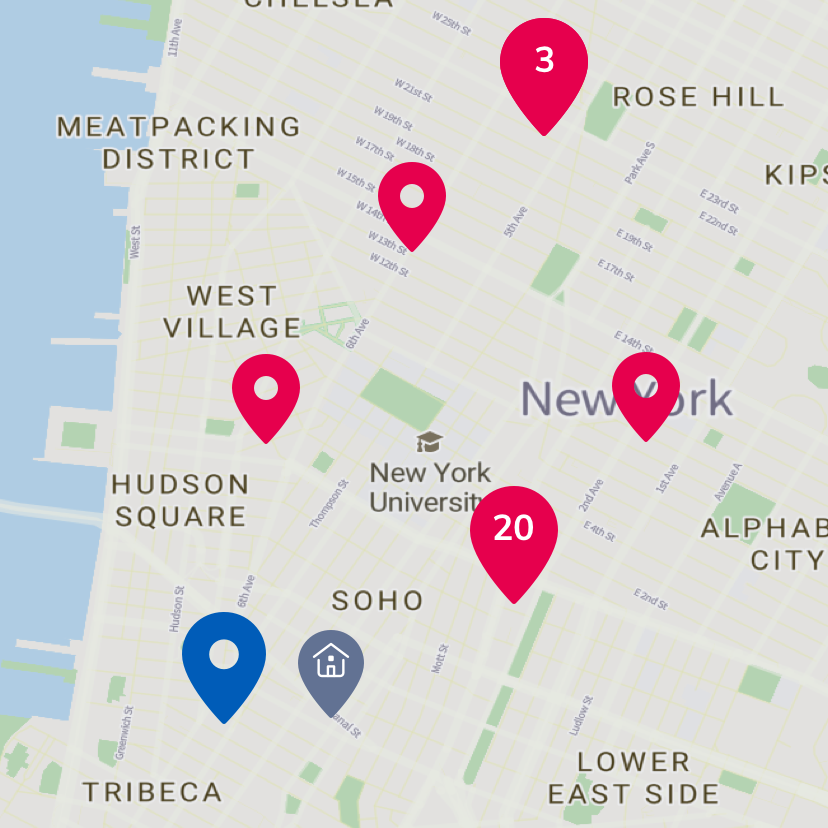
Start with a map. Not a metaphor. An actual map of where your new families live.
Two useful things fall out of it. The first is clusters. Three families in the same postcode who have no idea they are neighbours, and who between them could turn four separate school runs into one. Lift sharing is not a soft benefit. For a working parent it is the difference between their child doing the after-school club and not doing it.
The second is the outliers. The family two villages out. The single household in an area where nobody else from the school lives. Those are the families who will quietly miss the parties, the clubs and the informal Saturday things, and whose child's sense of belonging will show up in your 2029 data as a number you cannot explain.
You cannot see either of those in an attendance report.
You can see both on a parent map, and enough families join one to make it reliable. Across the schools we work with, it is unusual for fewer than a third of parents to sign up to the map that helps them find other families nearby. A third is roughly the floor rather than the target, and it is already enough to show you where the clusters are and which families are sitting on their own.
Then act on it, before the friendships set.
2. Partnership that does not add to the mental load
The white paper commits to minimum expectations for home-to-school partnership. The reported shape covers five areas: timely communication, high expectations of families, support through transitions, empowering families to support learning at home, and building a school culture of parental involvement. It explicitly names barriers around language and finances, and barriers facing white working-class families.
The evidence base for doing this well is strong. The Education Endowment Foundation puts effective parental engagement at around four months of additional progress a year. Yet as Schools Week reported in March, drawing on Dr Cat Jones's research, only about 10 per cent of teachers say they have had any training in parental engagement at all. Parentkind's national survey found more than half of secondary parents do not get clear information about supporting learning at home.
So the gap is real. But look at how most schools plan to close it. More newsletters. More workshops. More things for parents to attend, read and respond to.
There is no point pretending otherwise. Most parental engagement strategies add to the mental load of the very families who have the least slack.
The alternative is to stop treating parents only as recipients of the school's effort and start treating them as a resource for each other. Parents will do work for other parents that no school could afford to staff.
I mean groups that parents form themselves and run themselves:
- Parents navigating SEND, who will hand each other the practical knowledge that took them two years to acquire
- Working parents, who solve each other's wraparound and pick-up problems in a way no school policy can
- Parents returning to work after a career break
- Families new to the area, and families new to the country, who need to know how the uniform, the trip forms and the parents' evening booking system actually work
The school does not run these groups. The school makes them possible, then gets out of the way. That is the difference between a partnership and a broadcast.
Connection before day one
One of those five areas is support through transitions. Read that literally and the work starts before the child arrives.
So ask how you welcome new families now. Most schools send a pack. Some run a tour. Very few give a new family any way to meet the other families joining at the same time, in the same year group, before the first morning.
That gap is more fixable than it used to be. Applicants and new joiners are already flagged as such in your school information system, and community platforms can now read that through, so incoming families can be connected over the summer rather than in October once the groups have set. We see what happens next fairly regularly at Classlist: parents organising picnics, park meet-ups and coffee mornings in August, before term has started.
The value is not the picnic. It is what the picnic removes. A child who already knows one face is less anxious on the first morning. So is the parent. And a family whose first experience of your school was another parent being welcoming to them in a park in August starts the year on your side rather than watching from a distance.
The parent commitment curve
There is a sequencing mistake schools make constantly, and the white paper's ask for a culture of parental involvement is going to make it worse before it makes it better.
The school needs volunteers. So the school asks for volunteers. It puts out a general call, gets the same eleven people who always say yes, and concludes the rest of the parent body is not interested.
That is not what is happening. The ask is simply too big for where most families are standing.
We call it the parent commitment curve. In our experience, a parent needs a small group of other parents like them, people they already trust, before they will consider getting involved in anything at all. Involvement is not the first ask. It is the third or fourth.
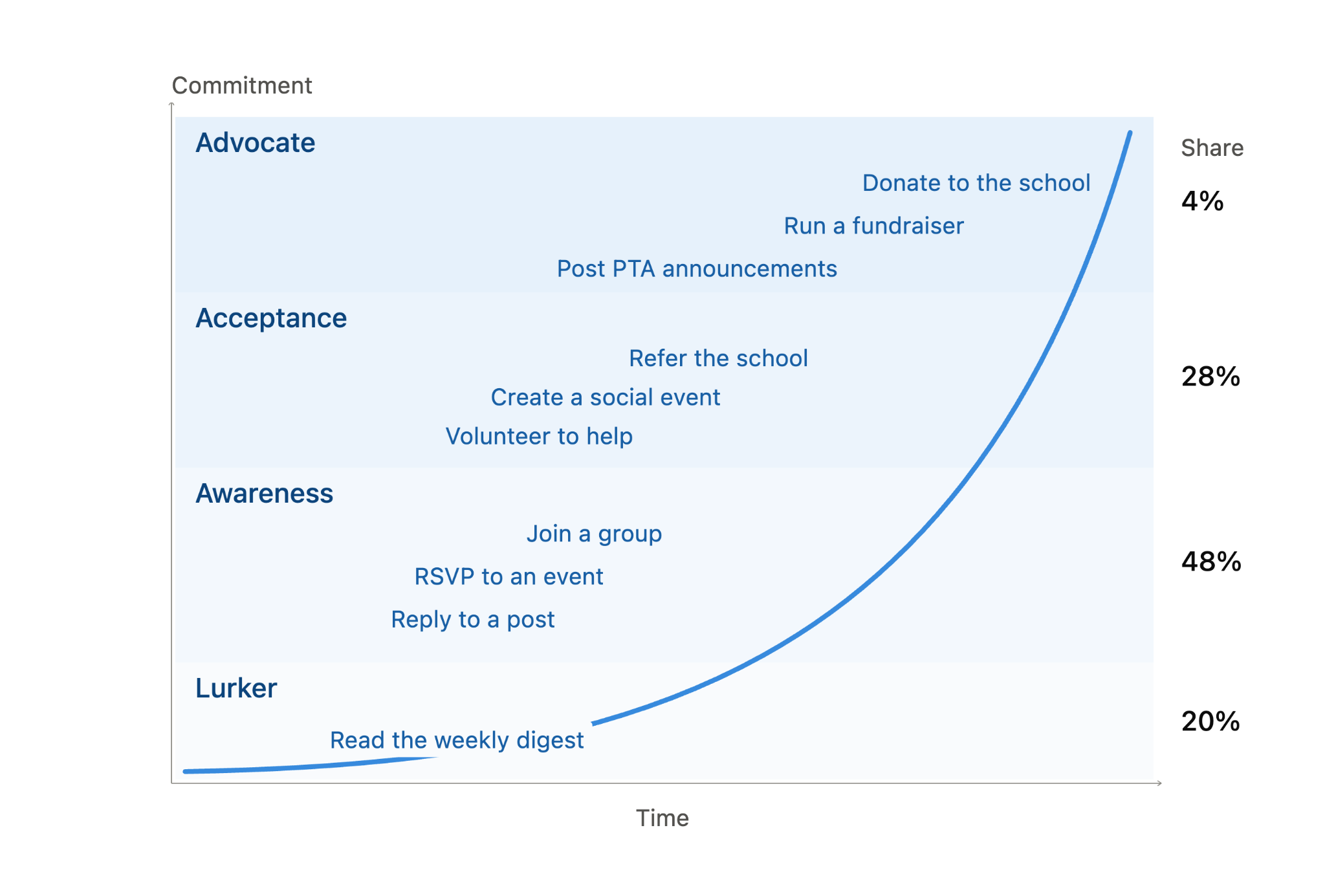
We map it in four stages. Lurkers read the weekly digest and do nothing else. Aware parents start to respond: they like or reply to a post, invite a family member, RSVP to an event, join a group. Accepting parents move from consuming to creating: posting to a class group or the marketplace, volunteering, organising a private social event, recommending the school to prospective parents. Advocates run things, and eventually give: PTA announcements, fundraising events, donating to the school.
Then look at how parents actually distribute across those stages. Roughly half sit in the second band. About a fifth never leave the first. A quarter reach the third. Around one in twenty five becomes an advocate.
Read that last figure again, because it reframes the whole problem. When a school puts out a general call for someone to run the Christmas fair, it is speaking to about 4% of its parent body. The other 96% are not refusing. They are three or four steps below the ask, and nobody has offered them the step in between.
So the useful question is not how do we get more volunteers. It is: where is this family on the curve, and what is the next step that is only slightly harder than the last one?
Nobody goes from knowing no other parents and never attending anything to running the Christmas fair. If that is the jump you are asking families to make, you will keep getting the same eleven people, and you will keep reading it as apathy.
Low volunteer numbers are not a verdict on your parents. They are a diagnosis of your ladder.
Notice that all of this also answers a different part of the paper. Trusts face a consultation on local governance, annual parent forums and hearing parent and community voice. A school with active parent groups already has somewhere for that voice to come from. A school without them is about to schedule a forum and wonder who will turn up.
3. Complaints are what happens when the first two go wrong
The complaints numbers are genuinely alarming. Parentkind polling of 2,000 parents found 38 per cent had made a formal complaint in the past year, and estimated more than five million complaints nationally, with headteachers handling around five a week. National Governance Association research found 82 per cent of governors and trustees reported complaints rising over three to five years, half of them significantly. Tes has reported schools receiving long, legalistic, AI-generated complaint letters that take weeks to answer.
The government's own framing, from former minister Bridget Phillipson last September, was to "resolve issues before they become complaints".
That sentence is the whole strategy, and it is not a complaint system. It is a community.
Think about what a complaint actually is. It is a question that did not get answered, hardening over time into a grievance. The parent who cannot find out why the trip letter changed, who feels ignored for a fortnight, who then reads three inaccurate versions of the story in a WhatsApp group, escalates. The parent who asks in a trusted space and gets a straight answer within an hour, from the school or from another parent who has been through it, does not.
So schools now need two things, and they are not the same thing.
A ticketing system for complaints that have already formed. The white paper promises a digital solution. Until it arrives, the sensible interim is a proper ticketed helpdesk, a Zendesk or Freshdesk type tool, so that every parent contact has an owner, a clock and an audit trail. Ad hoc email cannot survive statutory timeframes. Some trusts are moving faster than the policy. One trust told Tes it has appointed an independent complaints and code adviser to handle high-profile cases informally before they become formal investigations, and reported that this stops a good number of them.
A community layer that stops questions becoming complaints in the first place. This is the bit no ticketing system does. A parent who feels heard, and who has other parents to ask, complains less. That is not a soft claim. It is the mechanism the Education Secretary described.
Buy only the first one and you will process complaints more efficiently while generating just as many.
4. Who is actually going to do this work?
Here is the question I have not seen answered anywhere in the coverage. The white paper hands schools a belonging measure, a partnership standard and a complaints process. Who does the work?
Not the head. Heads are already fielding five complaints a week. Not the marketing manager, who is running admissions. Not the class teacher, only one in ten of whom has had any training in this.
Here is the part that surprises UK leaders when I say it. This is a solved problem almost everywhere else.
Parent engagement officers are standard practice across the international school sector. They are particularly prevalent in the Middle East and Asia, where a school might be admitting families from thirty nationalities in a single year and simply cannot leave the welcome to chance. In those markets the role is not an experiment. It is a line in the staffing structure, alongside admissions and marketing, and nobody would consider opening a school without one.
The state sector has its own version. New York City created the parent coordinator role in 2003 and put one in every public school: a non-teaching member of staff whose job is to bridge families and the school, with a particular brief for newly arrived families and families of children with disabilities. Across the US, family engagement coordinator posts are commonplace.
So when the white paper asks English schools to build partnership, measure belonging and reduce complaints, it is asking them to do work that much of the rest of the world already staffs deliberately. We are not early here. We are late.
My prediction: within two years, UK schools and trusts will start recruiting part-time parent engagement officers. Some already are, and CPD providers here are quietly running Family Engagement Officer courses, which is usually the leading indicator of a role about to become normal.
Two honest warnings, because I would rather flag them now than watch schools learn them the expensive way.
First, define the role or it will be eaten. Chalkbeat's 2026 survey of NYC parent coordinators found them absorbing tech support, attendance chasing and whatever else had no other home.
I want to be blunt about the attendance part, because it is the mistake I expect UK schools to make first. The white paper ties attendance and belonging together, and every school now has an attendance target to hit. So the temptation to hand absence chasing to the new parent person will be considerable.
Do not do it. Attendance enforcement is statutory, adversarial and frequently involves families in crisis. It is full-time work sitting close to safeguarding. Put it on a part-time community role and you have destroyed the single asset that role depends on, which is being the person parents are not afraid to talk to. A parent engagement officer who also chases absence is just the school wearing a friendlier badge, and families work that out inside a term.
Better attendance is what this role produces, not what it does. The connection work comes first and the numbers follow.
Second, it tends to be paid badly. As one NYC coordinator put it, “Love doesn't pay the bills”. If UK schools create this role, define it tightly and fund it properly, or it will quietly become the person who books the hall.
5. The channel matters more than schools think
Every school already has a parent community. The question is whether the school can see it.
For most, the community lives in WhatsApp groups the school does not control, cannot moderate, and only learns about when something has gone wrong. That has three consequences worth stating plainly.
It becomes a misinformation channel. A rumour about a staff change or a safeguarding incident moves faster than the school's own communication, and the school is always answering a version of the story it did not write.
It cannot be used for the inclusion work the white paper asks for. You cannot deliberately connect an isolated family through a group you are not in.
And nobody can raise a concern safely. Reporting a problem in a WhatsApp group means confronting a neighbour in front of forty people you will see at the gate tomorrow morning. So people do not report. They screenshot, they complain elsewhere, or they say nothing and withdraw.
If a school is going to make the parent community part of how it meets these requirements, the channel needs to be one the school can stand behind. That means, at minimum:
- GDPR compliant, with a lawful basis the DPO is comfortable with and parents in control of what they share
- An official channel, so the school's version of a story is the one in the same place parents are talking
- Moderation and reporting that is confidential, so a parent can flag a problem without fear of it coming back at them
- Visible enough that the school can see which families are connected and which are not
- Structured, so parents can form their own groups by year, by class, by interest, by language, by shared circumstance.
This is the problem we built Classlist to solve, and I am not going to pretend otherwise. But the criteria stand whoever you choose. If your parent community platform cannot do those five things, it is not going to help you evidence belonging, partnership or complaint reduction to anyone.
6. Worth getting ahead of
I am not the one who has to deliver any of this, and I would not presume to tell a head how to run their term. But we watch schools in more than 40 countries do this work well and badly, and the ones who find the next three years easiest tend to move on the same handful of things early.
So, offered as observations rather than instructions.
- Decide who owns the parent community. One named person. If the answer is nobody, that is your answer about how this will go.
- Map where your new families live. Look for clusters who could share lifts, and for the outliers who will quietly struggle. Deal with the outliers first.
- Find the families in reception and Year 7 who are connected to nobody, and act before the friendships set.
- Work out where each family sits on the commitment curve, then design the next small step rather than the big ask.
- Enable parent-led groups instead of adding more parent-facing broadcasts. Start with SEND, working parents and families new to the area.
- Put complaints on a ticketed system now, with named owners and timeframes, ahead of the DfE's digital solution.
- Baseline your belonging measure this term, so you have something to compare against when the Pupil Engagement Framework lands.
- Build the pre-term welcome for next year's intake now, while this September's transition is still fresh in everyone's mind.
- The white paper treats belonging, partnership and complaints as three workstreams. Schools that treat them as one, and that recognise parents as the people doing most of the work, will find the next three years considerably easier than schools that do not.
---
I would like to hear how you are approaching this. If you are building a parent engagement role, running parent-led groups, or trying to get ahead of the complaint handling changes, contact me and tell me what you are finding. We read and answer everything personally.
Are you on Classlist yet?
Classlist's award-winning parent communications app is the safer alternative to public social networks. It's easy to set up! Be amongst more than 400,000 parents using Classlist in 40+ countries. Get started today!