
Halloween 2026: the date that changes your plans
Halloween 2026 falls on Saturday 31 October. That leaves the school days before it for your event, and for many schools those days are limited. In England and Wales, most schools are on half term from 26 to 30 October, so the last chance in term time is the week of 19 October. International schools set their own October breaks, so check your calendar first. Either way, there are about three weeks to plan.
The ideas that work best this year are also the quickest to set up. Families are watching what they spend, and a simple, local event is easier for them to say yes to. This guide covers what is trending in 2026, eight easy ideas for schools, how year group events can bring in more families, and how to take money without a cash tin.
Scottish schools mostly break in mid October and are back before Halloween. If your school is open that week, Friday 30 October is a natural date.
Quick answer
The easiest Halloween events for PTAs in 2026 are a year group Halloween disco, a pre-loved costume swap, a pumpkin carving competition, a boot or treat in the school car park and a classroom door trail. Run them on a school day before Halloween: the week of 19 October for most UK schools, or Friday 30 October if your school is open that week. Sell tickets in advance on Classlist, so parents pay online and volunteers scan a QR code on the door.
What's trending for Halloween in 2026
In the US, the National Retail Federation expects Halloween spending of $13.5 billion in 2026, or $115.14 per person. Its survey of 8,000 adults found 79% expect higher prices this year, and 34% plan to reuse items they already own. Many are using AI tools to help them shop.
Families outside the US are more cautious. In the UK, GlobalData found 60% of UK Halloween shoppers planned to cut back and many see Halloween as a waste of money. A Finder survey found 63% of UK adults planned to spend under £20, or nothing at all.
American PTAs and PTOs return to the same few formats each year:
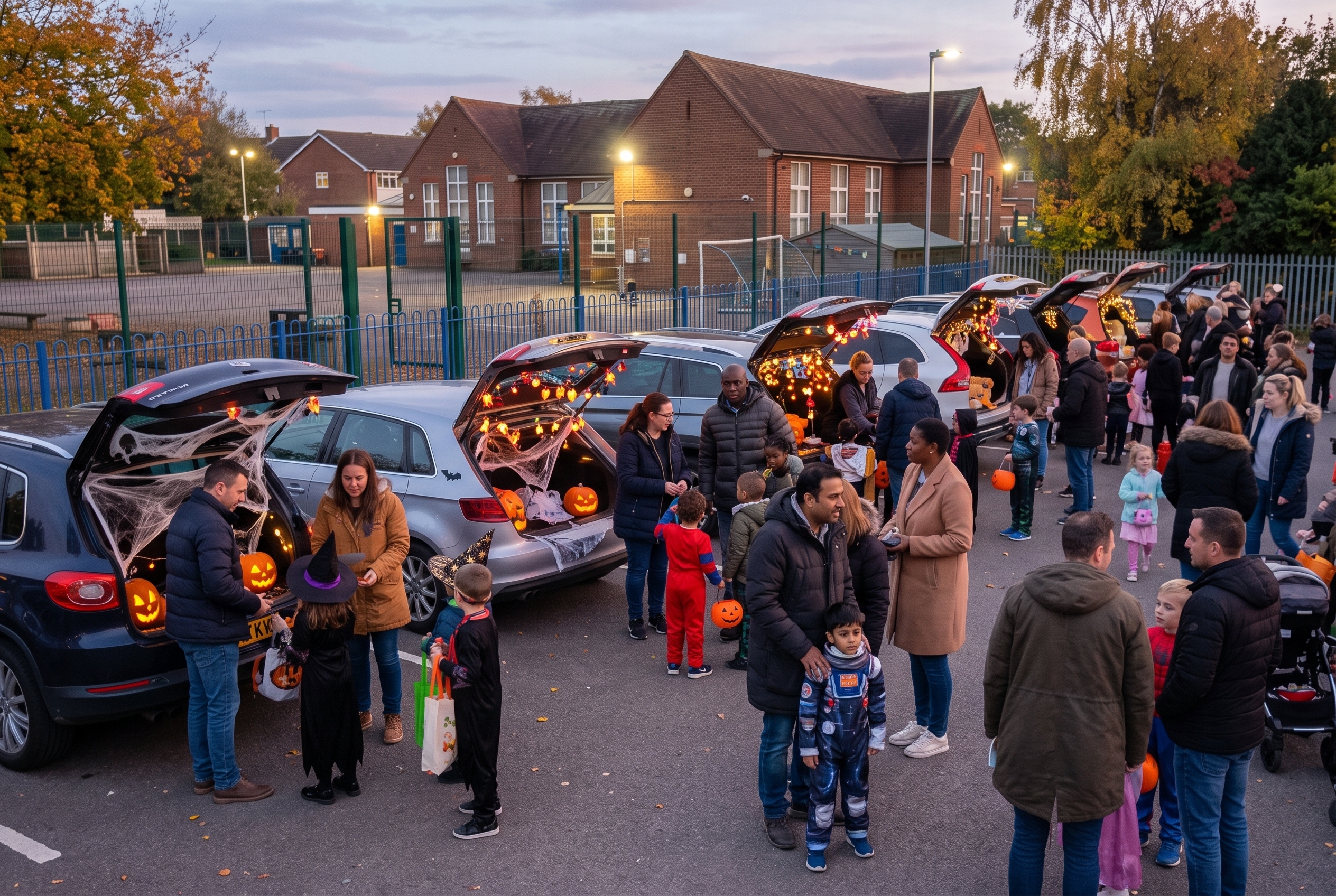
- Trunk or treat: families decorate their car boots and hand out treats in the school car park.
- Halloween halls: trick or treating through decorated school corridors, with a family ticket.
- Fall festivals: games, food and a costume parade, often paid for with bundles of game tickets.
- The Teal Pumpkin Project: non-food treats, so children with allergies can join in.
- "Silly, not scary": events pitched at younger children.
Most of these work in schools outside the US with small changes. We have left out hayrides, haunted houses and bouncy castles. They take longer to arrange, and need insurance and risk assessments that are hard to complete in three weeks.
8 easy Halloween ideas for PTAs in 2026
Each idea can be set up in under three weeks. Most need only the school hall or playground, a few volunteers and a ticketed event on Classlist.
1. Year group Halloween disco
Book the hall after school and run short sessions for one or two year groups at a time. For example, Reception and Year 1 (or Kindergarten and Grade 1) at 3.30pm, then the next two year groups at 4.30pm. Smaller sessions are easier to staff and less overwhelming for younger children. Put a glow stick and a drink in the ticket price, so there is nothing extra to pay on the night.
Set-up time: 1 week. Charge: a ticket per child, sold in advance on Classlist.
2. Boot or treat
A British take on trunk or treat. Volunteers park in the school car park before families arrive, open their boots and decorate them. Children walk from car to car collecting treats. You will need the head's permission, marshals, and a rule that no cars move while the event is running.
Set-up time: 2 weeks. Charge: a ticket per child, plus a box at the school office for treat donations.
3. Pre-loved costume swap
Ask families to drop off outgrown costumes the week before. Hang them on rails in the playground at pick-up, and let families swap or take one for a small donation. It costs almost nothing to run and suits families who are cutting back. It also clears out dressing-up boxes before Christmas.
Set-up time: a few days. Charge: a suggested donation by card reader, or free with a donation box.
4. Pumpkin carving competition
Families carve a pumpkin at home and bring it in on a set day. Line them up along the playground wall for a pumpkin display at pick-up. Give a prize for each year group, so more children have a chance of winning.
Set-up time: 1 week. Charge: an entry fee per pumpkin on Classlist.
5. Classroom door trail
This is a UK take on Halloween halls. Each class decorates its classroom door, and families walk the trail after school. Keep it silly rather than scary for younger years. Families vote for their favourite door, and children collect a treat bag at the end.
Set-up time: 1 to 2 weeks, with teacher agreement. Charge: a family ticket that includes treat bags.
6. Teal pumpkin treat trail
Offer non-food treats such as stickers, pencils and glow sticks, marked with a teal pumpkin. Children with allergies or diabetes, and families who avoid sweets, can then join in fully. This can be added to any of the other ideas.
Set-up time: a few days. Charge: include it in the ticket price of another event.
7. Family film night
Show a Halloween film rated U or PG in the hall. Children can come in costume or pyjamas, and families pre-order snack bags with their tickets. Check that the school's film licence covers a ticketed screening. If not, your country's film licensing body can issue a licence for a single film. In the UK this is Filmbankmedia.
Set-up time: 1 to 2 weeks. Charge: a family ticket with an optional snack bag.
8. Monster bake sale
Children decorate cupcakes or biscuits as monsters at home, and the PTA sells them at pick-up. Add a bake off with a winner per year group. Ask bakers to list ingredients on a label, so parents can check for allergens.
Set-up time: 1 week. Charge: on-the-day sales with a contactless card reader.
Why year group events reach more families
Patterns across thousands of events hosted on Classlist show that year group (or grade) events attract higher response rates than whole-school events. Mid-sized events with 101–250 guests, roughly the size of a year group or Key Stage, have the highest response rates, reaching 92.5%. Whole-school events receive fewer responses. One possible reason is that families feel less of the close-knit connection they have within their child's class. An event centred on their child's peers gives parents a clearer reason to attend and volunteer.
Smaller events feel more personal. Parents are more likely to recognise someone there. A family new to Reception, or a parent who does not speak the school's main language, may hesitate to attend a large event full of unfamiliar faces. A clearly named event, such as the “Year 2 Halloween disco”, makes it easier to see who it is for and why they belong there.
To make sure families know the event is theirs:
- Name the year group in the title: "Year 3 Halloween Disco", not "PTA Halloween Disco".
- Send the invite only to that year group on Classlist, so it reads as a personal invitation.
- Ask class reps to post a reminder and offer to meet new families at the door.
- Say what the ticket includes, so there are no surprise costs on the night.
- Say costumes are optional. A child in school uniform is just as welcome.
- Offer a few free places through the school office, for families who would otherwise stay away.
- Use an autumn theme for some events. Some families do not celebrate Halloween for religious or cultural reasons, and an autumn disco or pumpkin display still includes them.
Taking money without the cash tin
Cash creates work for volunteers: floats to collect, money to count, and trips to the bank. It also makes it hard to know how many families are coming until they turn up.
Sell tickets in advance on Classlist
- Create a ticketed event on Classlist. Add ticket types such as child, adult or family, or one per session time.
- Share it with the year groups it is for. Parents buy and pay on their phones.
- Each ticket comes with its own QR code.
- On the night, volunteers scan each QR code at the door. Families are checked in, and a ticket cannot be used twice.
- You know numbers before the event, so you can plan food, treat bags and volunteers.
Card readers for on-the-day sales
For bake sales, glow sticks and drinks, a contactless card reader such as SumUp, Zettle or Square (or a local equivalent) lets parents pay by card or phone. The readers are cheap to buy and charge a small fee per payment. Check whether your PTA qualifies for a charity rate.
Tokens for games stalls
For quick games, sell a bundle of game tokens with the ticket and hand them out at the door. Children give a token at each stall, so stall volunteers never handle money.
Your three week countdown
This plan works back from an event in the week of 19 October. If your school's break falls at a different time, move each step to match.
This week (by Friday 9 October)
- Pick one idea and agree a date with the head.
- Book the hall, playground or car park.
- Create the ticketed event on Classlist.
Next week (12 to 16 October)
- Send the invite to each year group on Classlist.
- Ask class reps to post a personal reminder.
- Recruit volunteers, including two people to scan QR codes on the door.
- Buy glow sticks, treats and decorations, and reuse what you have from last year.
Event week (19 to 23 October)
- Check ticket numbers and adjust food and volunteers.
- Charge the phones and card readers you will use on the night.
- Take photos, with permission, for the school newsletter.
Halloween 2026 FAQs for PTAs
When is Halloween 2026?
Saturday 31 October 2026.
Is Halloween in half term in 2026?
For most schools in England and Wales, yes. Half term runs from Monday 26 to Friday 30 October, and Halloween is the Saturday at the end of it. Scottish schools mostly break earlier in October, and Northern Ireland schools are mostly off on 29 and 30 October. International schools set their own dates, so check your school calendar.
When should a PTA hold a Halloween event in 2026?
In the last week of term before your October break. For most UK schools that is the week of 19 October. If your school is open the week of Halloween, Friday 30 October works well for an after-school disco or film night.
What is the easiest Halloween fundraiser for a PTA?
A pre-loved costume swap or a pumpkin carving competition. Both can be organised in a few days with very little to buy.
What is a boot or treat?
A British take on the American trunk or treat. Volunteers decorate their car boots in the school car park, and children go from car to car collecting treats.
What is the Teal Pumpkin Project?
A way of including children with food allergies. A teal pumpkin shows that non-food treats, such as stickers or pencils, are on offer.
How can a PTA take payments without cash?
Sell tickets in advance on Classlist, where each ticket has a QR code that volunteers scan at the door. Use a contactless card reader for anything sold on the day.
How do we make a Halloween event inclusive?
Run it by year group, say costumes are optional, offer non-food treats and keep it silly rather than scary. Offer a few free places through the school, and consider an autumn theme for families who do not celebrate Halloween.
https://www.classlist.com/blog/9-halloween-ideas-for-your-school-party
Are you on Classlist yet?
Classlist's award-winning parent communications app is the safer alternative to public social networks. It's easy to set up! Be amongst more than 400,000 parents using Classlist in 30+ countries. Get started today!