
The arrival of Agentic AI changes things. Not incrementally — fundamentally.
Why does this matter?
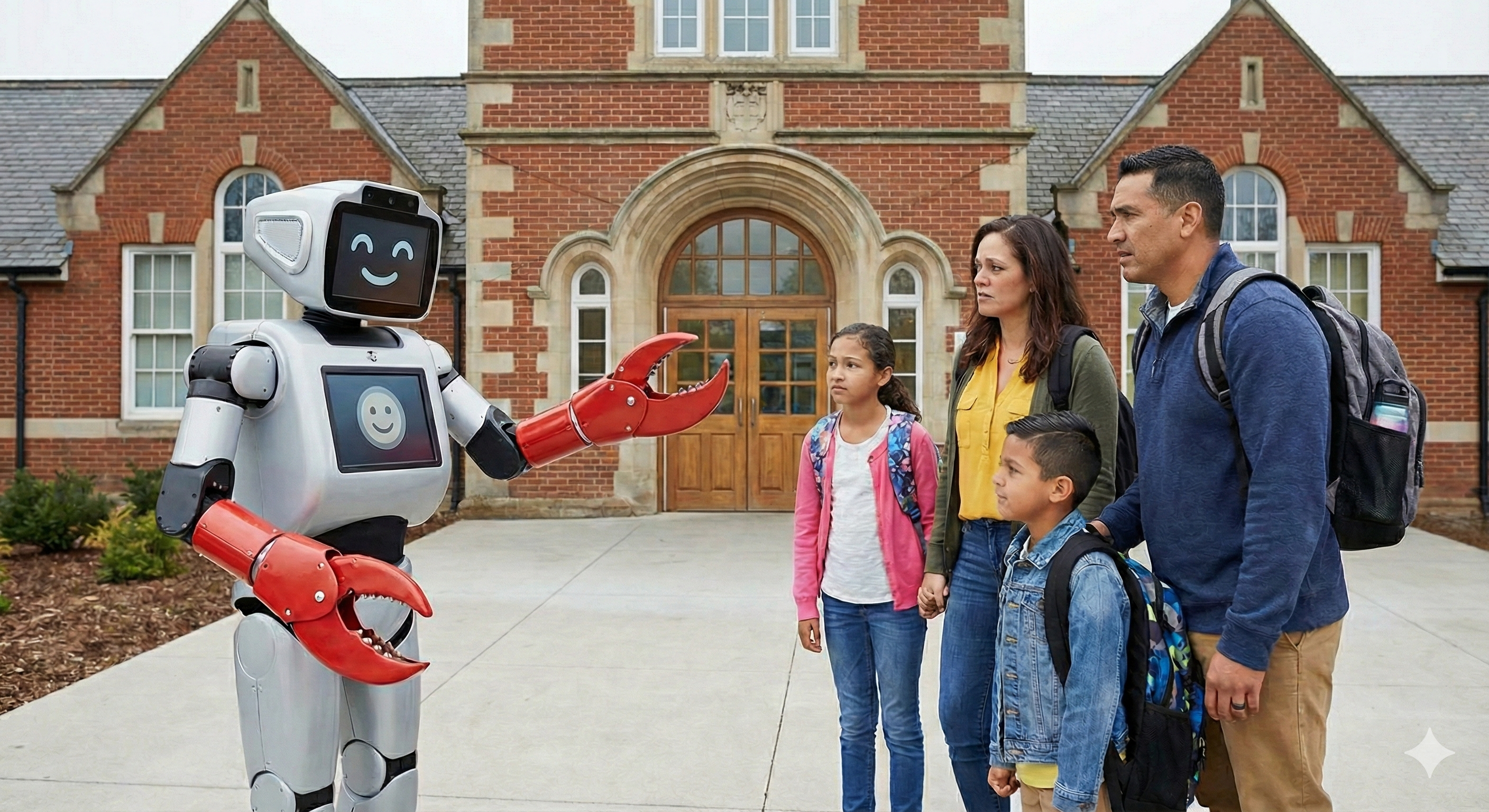
For the first time, parents have access to genuinely agentic AI: software that doesn't just answer questions but takes action. It can scan a school calendar, negotiate a childcare arrangement, follow up on a club application, and coordinate a family's entire school-related life — autonomously, in the background, without the parent lifting a finger.
The implications for school communities are significant and largely unexamined. Because if parents can now delegate the entire administrative layer of school life to an agent, so can your admissions team. And your PTA. And your new family welcome committee. And your volunteer coordinator.
Your Admissions Director is already overwhelmed. The enquiries pile up, open day follow-ups slip, and three prospective families haven't heard back in a week. An agent like Open Claw could fix all of this — responding to every enquiry within seconds, personalising follow-up sequences, scheduling visits, matching new families to existing ones with children the same age.
For an admissions director, it looks like a dream.
But here's the question senior leaders need to sit with before they reach for that solution: What if the thing families are actually paying for is the friction?
What Schools Are Really Selling
The brochure says "academic excellence." The website says "pastoral care." But walk into any successful school's open morning and watch what actually converts a prospective parent. It's not the exam results slide. It's the head of year who remembered a child's name from twenty minutes ago. It's the current parent volunteer who stayed back to give an unrehearsed, enthusiastic endorsement. It's the sense that this place sees people.
That feeling — of being genuinely welcomed into a community — is not a feature. It is the product.
Owen Eastwood, in Belonging, describes what he calls "Whakapapa" — the living chain of identity and connection that binds a group together across time. School communities are the most powerful version of this most of us will ever experience. They are built, slowly, through thousands of small human moments: the coffee morning where two parents discover they grew up in the same town; the volunteer who spends her Saturday building the summer fete and is thanked by name at assembly on Monday.
If we automate those moments away, we don't just lose efficiency savings — we lose the reason families chose your school in the first place.
The Admissions Paradox
Here is the paradox senior leaders need to sit with: the more you use AI agents to streamline admissions, the more you risk eroding the very culture that drives your admissions pipeline.
Think about the journey. A family hears about your school through word of mouth — almost always from another parent. That parent is an advocate because they feel part of something. They feel part of something because they were personally welcomed, personally involved, personally recognised.
Now imagine that journey redesigned for efficiency. The enquiry is handled by an agent. The follow-up is automated. The open day invitation is templated. The new family joins and finds that the welcome coffee morning is scheduled by a bot, and their matched "buddy family" was suggested by an algorithm. At every touchpoint, someone did something to them rather than with them.
They may not be able to articulate why, but something will feel off. The warmth will be missing. And they won't become advocates. They'll become consumers — and consumers leave for a better deal.
Where AI Should and Shouldn't Go
This is not an argument against technology. It is an argument for intentionality.
There are tasks in your admissions and community function that are genuinely administrative: processing paperwork, chasing unsigned forms, sending out event logistics, collating dietary requirements. These are not human moments. Automating them doesn't hollow out your community — it frees your team to spend more time on the moments that matter.
But there is a second category of tasks that feel administrative but are actually relational. Following up with a family who came to an open day and went quiet. Welcoming a new parent who seems hesitant to get involved. Thanking the volunteer who ran the book fair. Charles Vogl, in The Art of Community, calls these the mechanisms of his "Seven Rings of Belonging." They are the rituals, the recognitions, and the shared efforts that make people feel they belong to something real.
An agent performing these tasks doesn't just do them less well. It breaks them entirely. Because the point of being thanked is not to receive information that gratitude exists. It is to know that a human being noticed you.
The Retention Risk You Aren't Measuring
Most schools track admissions data carefully. Fewer track community health — and almost none model the relationship between the two.
Consider this: if your AI agent handles new family onboarding so efficiently that no existing parent ever has to get involved, you have just eliminated your most powerful retention mechanism. You have removed the moment where the current parent feels needed, contributes something real, and deepens their own commitment to the school. You have removed the moment where the new family forms their first friendship.
You haven't just affected the new family's experience. You've quietly undermined the belonging of every parent who would have been involved.
The soul isn't sucked out in one dramatic moment. It leaches out, slowly, across a hundred small efficiencies.
A Framework for Senior Leaders
Before your school deploys agentic AI in admissions or community functions, I'd suggest your leadership team works through four questions:
1. Is this task administrative or relational? Administrative tasks — process, logistics, information — are good candidates for automation. Relational tasks — recognition, welcome, advocacy, conflict — are not.
2. Who used to do this, and what did they get from doing it? Many community tasks benefit both parties. The volunteer gains as much as the family they welcome. Automating the task may solve one person's problem while quietly impoverishing another's experience.
3. What does this signal to our community? Families notice when human contact is replaced by automation, even when they can't name it. Ask what your choices communicate about how much you value personal connection.
4. Where will the time saved actually go? Efficiency gains are only worth their name if the freed-up human time is reinvested into deeper connection. If it is absorbed into other admin, you have lost twice.
The School That Gets This Right
The schools that will thrive in an AI-mediated world won't be the ones that automate the most. They'll be the ones that are most deliberate about what they refuse to automate.
They'll use AI to clear the path — to eliminate the paperwork, the form-chasing, the scheduling noise — so that their people can be more human, not less. They'll protect the moments that build belonging as fiercely as they protect their academic standards, because they'll understand that one drives the other.
The families of the future will have more choice, more information, and higher expectations than any generation before them. They will be able to tell the difference between a school that welcomes them and a school that processes them.
The efficient school is easy to build. The 'in real life' connected school is worth building.
Susan Burton is the CEO of Classlist. Classlist helps schools build authentic parent communities — moving beyond communication tools to genuine belonging. If your school is thinking about how to balance technology with community, we'd love the conversation.
Are you on Classlist yet?
Classlist's award-winning parent communications app is the safer alternative to public social networks. It's easy to set up! Be amongst more than 400,000 parents using Classlist in 30+ countries. Get started today!